January 10
January 10 is the 10th day of the year in the Gregorian calendar; 356 days remain until the year's end. It falls in winter (northern hemisphere) and under the astrological sign of Capricorn.
External references
Curated jump-off points to the major almanacs, encyclopaedias and primary sources for this date.
Astronomy
On January 10 the Sun's declination is approximately -22.0°. At this latitude the Sun is south of the celestial equator, giving the Northern Hemisphere shorter days than nights.
For specific rise/set times at your location, see the U.S. Naval Observatory, or the NASA APOD archive for any imagery published on a January 10.
Position in the year
Holidays & observances
No widely-observed holidays catalogued for this day in our base set. See the external almanacs above for region-specific observances.
Events
A selection of widely-documented historical events that took place on this date. Years marked BCE follow standard astronomical convention.
- 49 BCE — Julius Caesar crossed the Rubicon, a treasonous act under Roman law that began civil war. ↗(2075 years ago)
more
The phrase "crossing the Rubicon" is an idiom meaning "passing the point of no return". Its meaning comes from the crossing of the Rubicon river by Julius Caesar in January 49 BC at the head of the 13th Legion. Caesar was not allowed to command an army within Italy proper, and by crossing the river with his forces was defying law and risking death.
 1776 — Thomas Paine's pamphlet Common Sense was published in Philadelphia. ↗(250 years ago)
more
Common Sense is a 47-page pamphlet written by Thomas Paine in 1775–1776 advocating independence from Great Britain to people in the Thirteen Colonies. Writing in clear and persuasive prose, Paine collected moral and political arguments to encourage common people in the Colonies to fight for egalitarian government.
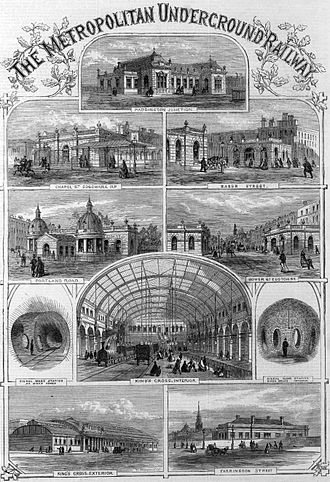 1863 — The Metropolitan Railway, the world's first underground passenger railway, opened in London. ↗(163 years ago)
more
The Metropolitan Railway was a passenger and goods railway that served London from 1863 to 1933, its main line heading north-west from the capital's financial heart in the City to what were to become the Middlesex suburbs. Its first line connected the main-line railway termini at Paddington, Euston, and King's Cross to the City.
 1920 — The League of Nations came into being with the entry into force of the Treaty of Versailles. ↗(106 years ago)
more
The League of Nations was the first worldwide intergovernmental organisation whose principal mission was to maintain world peace. It was founded on 10 January 1920 by the Paris Peace Conference that ended the First World War.
 1946 — The first General Assembly of the United Nations opened in London. ↗(80 years ago)
more
The United Nations General Assembly is one of the six principal organs of the United Nations (UN), serving as its main deliberative, policymaking, and representative organ. Currently in its 80th session, its powers, composition, functions, and procedures are set out in Chapter IV of the United Nations Charter.
Notable births
 1903 — Barbara Hepworth, English sculptor. ↗(123 years ago)
more
Dame Jocelyn Barbara Hepworth was an English sculptor. Her work exemplifies Modernism and in particular modern sculpture. Along with artists such as Ben Nicholson and Naum Gabo, Hepworth was a leading figure in the colony of artists who resided in St Ives during the Second World War.
 1949 — George Foreman, American boxer and entrepreneur. ↗(77 years ago)
more
George Edward Foreman was an American professional boxer, businessman, minister, and author. In boxing, he competed between 1967 and 1997, and was nicknamed "Big George". He was a two-time world heavyweight champion and an Olympic gold medalist. He is the namesake of the George Foreman Grill.
Notable deaths
 1971 — Coco Chanel, French fashion designer. ↗(55 years ago)
more
Gabrielle Bonheur "Coco" Chanel was a French fashion designer and businesswoman. The founder and namesake of the Chanel brand, she was credited in the post–World War I era with popularising a sporty, casual chic as the feminine standard of style.
Numerical & calendrical curiosities
| Day-of-year (10) | 2 × 5 · composite (no) |
|---|---|
| Days remaining (356) | 2^2 × 89 |
| Date code DDMMYYYY | 10012026 · no palindrome in next 200 years |
| Sun declination | -22.03° (Cooper approximation) |
| Distance from solstice | 21 days |